We caught up with Artistic Director of Far From The Norm, Botis Seva, ahead of the upcoming performance of BLKDOG at Riley Theatre.
Book tickets
I started dancing at the age of 15. At secondary school, I was lucky enough to have an active dance department and we regularly had guest choreographers teaching, such as Tony Adigun from Avant Garde Dance. This inspired me to enter the annual school talent shows and from here, I presented small works through a variety of community dance platforms.
My reason for starting to dance was music. Before I was dancing, I was rapping at my local youth club and I was immersed in grime music. The school was tough and with the restrictions and conflict from many of my secondary school teachers, music gave me freedom but dance gave me an opportunity to unleash my frustrations.
Far From The Norm is a collective of dance artists who are not only my soldiers in the studio and on the stage, but we are all friends. The current company has been with me now for 6 years and that is a highlight. Seeing the company grow and support each other both in and out of the studio – it’s really rare and we all know we have something special. One of my biggest challenges with the company was at the beginning, dealing with rejection from the industry and always working with an ever-changing line up of dancers because in the early stages people couldn’t commit.
My language comes from hip hop and the other street dance styles. I would describe it as free form hip hop as I use the core foundations physically, but I experiment with other theatrical devices, genres and artistic inspirations.
For me, hip hop on stage is about crafting and finding new ways to use the form and the culture. The idea is always to keep the energy of improvisation and use this as a tool to make the work.
I use personal experiences, life encounters and tap into my childhood memories to find new references and ideas to bring into the studio. These references instantly change when they are transferred to my body or my dancer’s bodies, it becomes an abstracted idea that takes a new form – which is an interesting process in itself.
We start with ideas both choreographically and musically, this happens in and out of the studio. I will offer motifs and physical inspirations from the piece and Torben will respond by creating samples of different music sounds and palettes. I then feed these sounds back into the studio to see what the impact is on the choreography, whether it informs something new, shapes existing material or, just doesn’t work (yet!).
Torben is sometimes in the studio to understand how the dancers are responding and feel the energy and weight of the movement, then he goes back into his cave to add what he felt was lacking, or needed developing musically. From here it’s an ongoing dialogue, continually feeding back on the layered versions that are growing constantly. This process doesn’t really stop for us, even when we are in show mode. We keep patterning the sounds until we find something that is right. It’s the same process choreographically too, the work is always evolving.
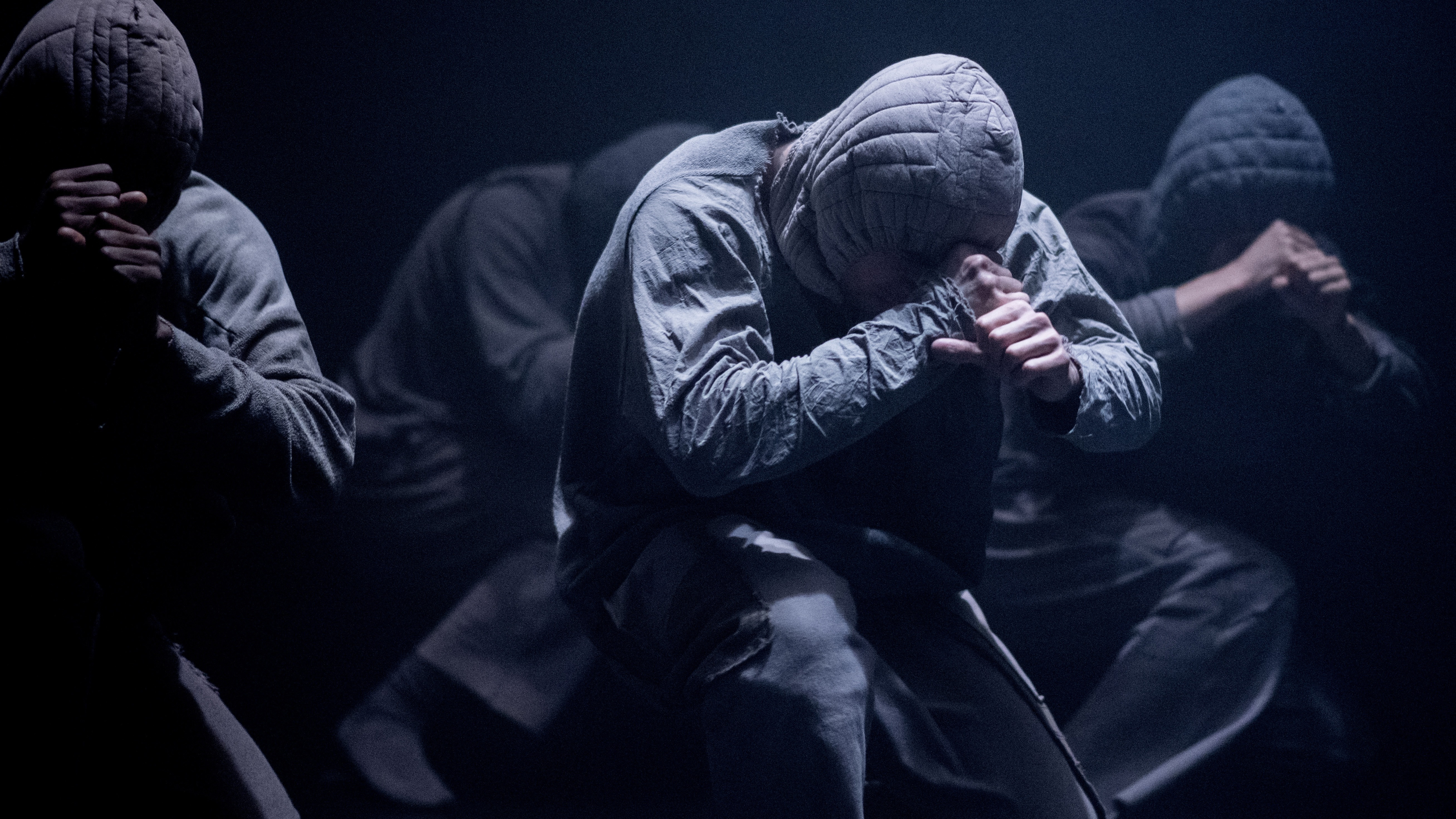
BLKDOG has developed since the Sadler’s Wells Reckonings extract in October 2018. There is light and shade, rather than just the dark side of the “story”. We delve further into the childhood references of the characters to understand how much of what we have to cope with now as adults has been engrained in us from birth.
But ultimately, you can expect poetic potency; an insight into how our younger generation are trying to survive in a world that is not built for them.
Well if I tell you everything then maybe you won’t want to come and see it.
There is dance.
There are real life struggles of trying to cope.
But ultimately, there is hope.