- Study
- Graduates
- What’s On
- Riley Theatre
- Take Part
- About
- Support us
- Search
This webpage is the ‘single comprehensive source of information’ required by the Office for Students (OfS registration condition E6).
These regulations came into force on the 1st of August 2025. This webpage aims to demonstrate the steps we are taking to protect students and will be updated regularly and reviewed in full annually.
We are committed to creating safer and more respectful environments where we actively prevent harm, foster transparency and empower students and staff to speak up when harmful behaviour occurs.
Harassment is unwanted behaviour related to a relevant protected characteristic (such as sex, race, disability, sexual orientation, religion or belief, or gender reassignment) which has the purpose or effect of either:
Harassment can be a single incident or persistent behaviour, and it can happen in person, online, or through third parties. It may be verbal, non-verbal, physical, or written.
Sexual misconduct means any unwanted or attempted unwanted conduct of a sexual nature and includes but is not limited to:
‘abuse of power’ means a situation where a relevant staff member exploits a position of power in relation to a student so as to apply pressure in a way which:
Consent is the agreement by choice to participate in an act (including but not limited to, a sexual act) where the individual has both the freedom and capacity to make that decision.
The following list of examples is also included with the Harassment & Sexual Misconduct Policy:
Please remember these are just examples and if something you have experienced does not fall within this list we encourage you to report it to us.
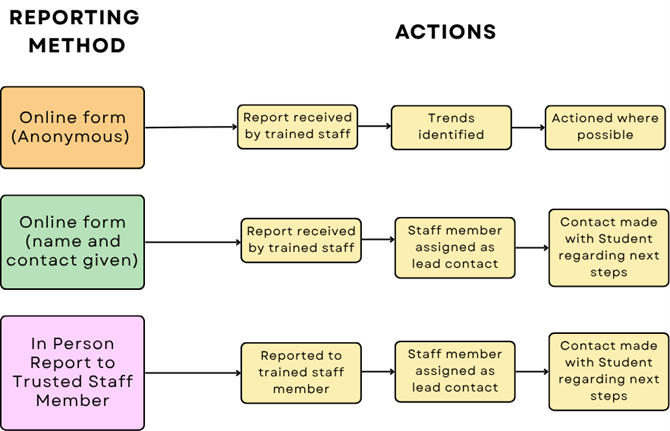
We understand reporting any incidents of harassment or sexual misconduct can be very difficult as such, there are a number of ways you can report to us. You can also report something you’ve witnessed or if you’re worried about someone else.
Online Reporting – NSCD Concerns Form
This is a short online form, designed to gather initial information to help us know how to best support you.
Contact a trusted member of staff
Listed below are members of staff trained to support students in this area. You can, however, approach any member of staff you feel most comfortable talking to too either via email or in person.
Safeguarding Lead: Tracy Witney
Designated Safeguarding Officers:
All reports are logged and reported to the EEDI Committee. These reports will always be anonymized to ensure individuals cannot be identified. This is to enable the school to monitor trends and track actions.
Concerns FormBook a wellbeing appointment via Moodle where you can discuss the following:
You can also directly contact our Head of Student Support
NSCD can provide support in accessing the following external services:
People often use the terms policy, procedure, and guidance as if they mean the same thing, but they actually serve different purposes. Here’s what each one means:
The following core policies are in place to protect students and staff at NSCD and are available on the NSCD Policy page:
The following policies are used to investigate reports of harassment and sexual misconduct:
Harassment & Sexual Misconduct
This policy:
Where a breach of the policy has occurred, the following policies determine the next steps and outcomes depending on whether it is a student or member of staff.
Student: Non-Academic Misconduct Policy
Where a student is found to have breached another school policy regarding non-academic matters they will investigated following the Non-Academic Misconduct Policy.
Staff: Disciplinary Procedures
Where a staff member has been found to have breached a school policy they will investigated following the Staff Disciplinary processes.
Support available
All students will be offered support in-house and directed to online resources available in the External Resources section of this page.
Timescales
In response to a disclosure or report, we aim to get back to a student within 24 hours.
Timescales for investigation are detailed within the relevant policies.
NSCD has designed a 3-tiered approach to student training on Harassment & Sexual Misconduct for all students:
1. Understanding Harassment and Sexual Misconduct
What it is, how to recognise it, and what to do if you experience or witness it. This will be delivered to all new students, in person during induction week, and to returning students at the start of the academic year.
2. Online Module
Within the first half term, all new students will be required to complete a short online module to demonstrate their understanding of harassment, sexual misconduct, how to report a concern, and how to access support.
3. Additional Training
In addition to core induction and online provision, NSCD delivers ad hoc, tailored training sessions across cohorts throughout the academic year. This provision is responsive by design, informed by student feedback, emerging themes, and sector guidance, and is reviewed on an ongoing basis by the Safeguarding Committee to ensure it continues to meet student need.
Monitoring Effectiveness
The effectiveness of this training is monitored through completion rates for the online module, student surveys and trends in reported incidents. Findings are reviewed by the Safeguarding Committee throughout the year and used to inform future training content and delivery.
All staff play a critical role in maintaining a safe and respectful environment. We provide comprehensive and ongoing training to ensure everyone understands their responsibilities in safeguarding and preventing and responding to harassment and sexual misconduct.
NSCD has designed a 3 tiered approach to staff training on Harassment & Sexual Misconduct:
Policies & Procedures
All staff receive training on key NSCD policies and procedures in place to protect our staff and students each academic year.
Online training
All staff complete Bullying and Harassment module delivered by TES.
Specialist External training
NSCD investigating team receive specialist training from an external provider to support the handling of harassment & sexual misconduct cases.
NSCD’s approach to preventing and responding to harassment and sexual misconduct is guided by a clear legal and regulatory framework. This ensures that our policies, training, and response processes are compliant, consistent, and focused on the rights and wellbeing of our students and staff.
This framework includes both statutory duties and sector-specific regulation from the Office for Students (OfS).
Condition E6 requires all registered higher education providers to:
“Take all reasonable steps to prevent harassment and sexual misconduct, and to respond effectively and in a timely manner to incidents and allegations.”
Under this condition, NSCD must ensure:
Read more about Condition E6 on the OfS website
NSCD must uphold freedom of speech principles, as set out by the OfS, ensuring that efforts to address harassment and sexual misconduct do not compromise lawful freedom of expression.
In addition to the OfS’s expectations, the university must also meet its duties under the following legislation:
3. Safeguarding Legislation
4. Health and Safety at Work Act 1974
At the Northern School of Contemporary Dance, we are committed to transparency, fairness, and the right of every individual to speak out.
We affirm that:
NSCD will never use a non-disclosure agreement (NDA), confidentiality clause, or any similar provision to prevent any member of our community from reporting experiences of harassment or sexual misconduct.
This applies to all formal or informal processes, including complaint resolutions, settlement agreements, and disciplinary outcomes.
We believe that:
This commitment forms part of our compliance with the Office for Students (OfS) Condition of Registration E6, and reflects our values as a specialist institution rooted in expression, integrity, and care.
If you have concerns about confidentiality clauses or feel pressured to stay silent, you are encouraged to speak to our Safeguarding Lead or Student Support Team, who will offer advice and advocate for your rights.
If you or someone you know is experiencing harassment or sexual misconduct, you’re not alone. The following organisations offer free, confidential, and specialist support across the UK.
Leeds Branch: https://supportafterrapeleeds.org.uk/
Freephone: 0808 802 3344
Text: 078 600 22 880
Email: support@sarsvl.org.uk
You can contact any member of staff you feel comfortable talking to. Specialist staff include:
The Data Controller is NSCD. Personal data about you is defined as any information relating to you that can be directly or indirectly identified. Your data will be processed in accordance with the General Data Protection Regulation and other relevant legislation. You have the right to see information about you kept on your student record. If you wish to see your record, you should discuss this with a member of the Quality Office . More information available in Privacy Notices.
Storage of Information
You have the right to expect that all information Student Wellbeing holds about you will be treated in a sensitive and respectful manner. Records will be held securely within Student Wellbeing and the Quality Office. General information will be held as defined in the Record of Processing Activity.
Student Data
As part of our regulatory obligations under the OfS Condition of Registration E6 (Management and Governance), we may be required to provide relevant data to the OfS and other bodies such as the OIAHE to ensure compliance with their expectations regarding the welfare and safeguarding of students.
We have committed to reporting the number of student cases including harassment and sexual misconduct annually on this page of the website. The detail of cases will not be published.
Sharing of Information
Information regarding a student disclosure will only be provided to those who ‘need to know’ and we make the commitment this will first be discussed and agreed with student.
Exceptional Circumstances
Where the safety of an individual student or another person is considered to be at risk or NSCD has received a Concern for Welfare, Student Wellbeing may take steps to minimise this risk. This may involve disclosing information to a third party.
Due to the size of our student population, NSCD does not publish case figures relating to harassment and sexual misconduct, as doing so could risk identifying individuals involved. However, this data is reported and monitored through the Safeguarding Committee, Senate, and the Board of Governors, ensuring effective oversight of this area and appropriate protection of students.
The Office of the Independent Adjudicator publish annual statements for each University which show the handling complaints and appeals for the preceding calendar year. This can be accessed here: https://statements.oiahe.org.uk