- Study
- Graduates
- What’s On
- Riley Theatre
- Take Part
- About
- Support us
- Search
Course Award: | Duration: | ISTD Application Deadline: | Application Deadline: | Places: |
MA | 2 years Part-time | Wednesday 28 April 2027 at 11:59pm | Wednesday 28 July 2027 at 11:59pm | 10 - 15 |
Enhance Your Expertise as a Dance Educator
The MA Professional Dance Pedagogy offers a flexible approach to PG study for established dance teachers. This course is delivered through online learning, students do not need to live in Leeds. Students on this programme have the opportunity to undertake a rigorous evaluation of their professional teaching practice through engagement with theories and frameworks for Reflective and Reflexive Practice and Dance Pedagogy, before identifying a specific area of their current practice for deeper interrogation through an Independent Research Project. Through this MA, students gain tools to deepen their understanding of dance pedagogy, apply research methodologies, consider ethical dimensions of dance teaching and learning, and enhance their professional identity. The programme combines theory and practice, encouraging critical thinking and transformation within the context of each student’s own teaching.
Delivered through online learning, the course promotes learning via discussion, debate, and shared experience. Students engage in an active Virtual Learning Environment with guided tasks, curated resources, and opportunities for both asynchronous and synchronous learning via discussion forums and Microsoft Teams.
Designed for dance teachers working in diverse settings—schools, communities, private studios, conservatoires, and professional companies—the MA allows students to remain embedded in their own practice while studying. It supports those seeking to strengthen their professional credibility or transition into higher education teaching roles.
The programme blends theory and practice throughout the learning experience and offers a pedagogical focus for dance teachers / practitioners who are looking to establish greater credibility in their identity as a dance teacher / practitioner, or to move into higher level teaching environments. Throughout the MA emphasis is placed on the individual professional practice of each student. Success on this programme is through the demonstrable ability to critically reflect, evaluate, analyse, and transform, through research, one’s own community of practice and contribution to the field of dance pedagogy.
The MA Professional Dance Pedagogy course has been specially designed for experienced dance teachers seeking to expand their pedagogical knowledge, enhance their ability to reflect critically on their own practice, and deepen their contribution to dance education across the sector.
Delivered fully online, the programme enables teachers to remain embedded in their day-to-day studio work while engaging with contemporary research, refining teaching methodologies, and developing the communication and advocacy skills needed in today’s dance education landscape.
This new fast‑track option recognises the learning and expertise gained through ISTD qualifications – particularly the DDP – allowing eligible members to top up their Level 6 diploma to a full Master’s degree in just one year.
Eligible home-fee paying postgraduate students can apply for a postgraduate loan from the Student Loans Company* to help with course fees and living costs
For detailed information on tuition fees, financial support, and associated costs for all courses, visit our Fees and Finance page here: www.nscd.ac.uk/study/fees-finance/postgraduate
*Please note: Funding from the Student Loans Company for Distance Learning is only available to students from England and Northern Ireland.
Fees | Year 2 only (with RPL) |
Home and Overseas: £10,610 (£5,305 per year) | £7,226 |
Recognition of Prior Learning (RPL)
NSCD recognises study completed at other higher education institutions, and credit from previous qualifications, or professional experience may count towards an NSCD award. Transfer is not automatic, and each claim is assessed to confirm the prior learning is current (normally within five years), relevant to the programme, and equivalent in level and volume to the modules it would replace. For details, see our Recognition of Prior Learning Framework. Please contact NSCD’s Quality Office if you would like more information: quality.office@nscd.ac.uk
What this means for the MA PDP is that applicants may request to transfer existing credit from prior training (ie: ISTD Diploma in Dance Pedagogy, ISTD Fellowship, or PGCE). Usually 60 credits can be transferred on entry via the RPL process, leaving students to take a 30credit transition module the summer before going into year 2 of the MA to take the remaining 90 credits.
Find out more
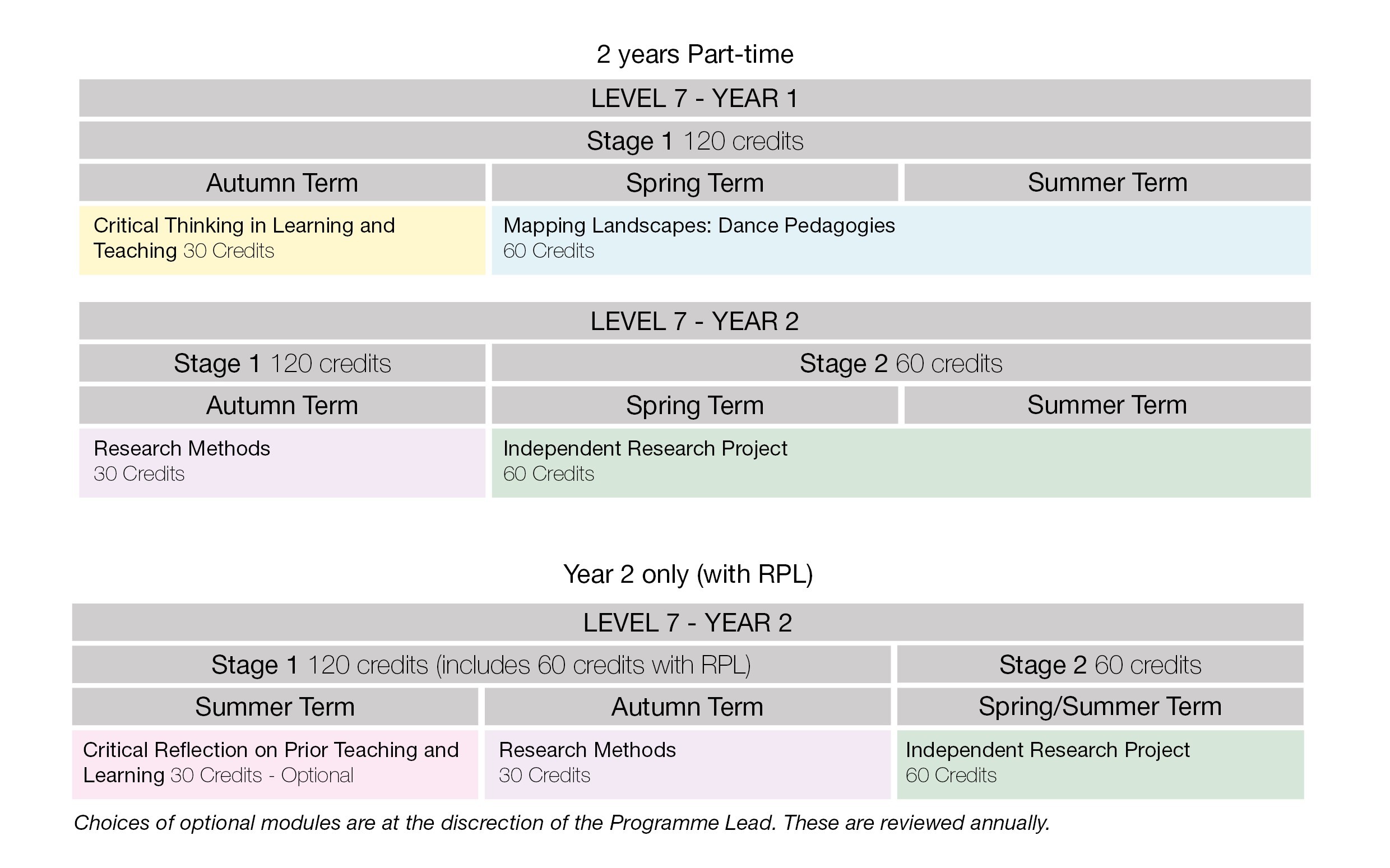
This module introduces you to approaches for identifying, situating, and developing your teaching practice through an awareness and application of wider fields of dance pedagogies, practice and scholarship. You will be introduced to established pedagogical theories as a way of mapping the landscape of your professional dance teaching practice. You will be encouraged to critically evaluate pedagogical theories/theorists in relationship with your experiential knowledge of dance teaching and explore through application how they may offer frameworks for different contexts of teaching and learning in dance. Through acknowledgement of globally diverse communities of dance, you will engage with critical debate as a process of identifying, situating, and developing your own dance teaching practice through critical enquiry. The relationship between theories, frameworks, and practice are central to the learning of this module and you are encouraged to consider notions of identity, diversity, and inclusivity through a range of social, cultural, political and pedagogical frameworks.
This module introduces you to significant theories and frameworks for reflective and reflexive approaches to critically evaluating your own learning experiences and teaching practice. The relationship between theories, frameworks, and practice are central to the learning of this module and you are encouraged to consider notions of knowledge, information, and understanding through diverse social, cultural and political constructs as well as pedagogical lenses. The culture of your own teaching practice is the starting point for this reflexive analysis and through dialogue with others on the programme, students and mentors, you are supported in challenging dominant structures through critical thinking.
This module centres your prior experiences of teaching and learning as critical to knowledge and awareness of dance pedagogy. The module uses theories and frameworks for reflective and reflexive practice to support you in critically evaluating your own learning through the process of undertaking prior teaching qualifications (eg:ISTD Diploma in Dance Pedagogy). The relationship between theories, frameworks, practice, and experience are central to the learning of this module and you are encouraged to consider notions of knowledge, information, and understanding through diverse social, cultural and political constructs as well as pedagogical lenses.
This module connects you to practice-centred research methods specifically tailored to the context of dance/arts teaching. The module focuses on developing skills in reflective inquiry and iterative research, encouraging you to investigate and improve your own teaching practice through exploratory and evidence-based methods. Emphasising participatory and practice-centred approaches, you will learn to design a project and how to implement and evaluate research projects that are directly relevant to teaching environments.
The Independent Research Project module will require you to critically examine a range of perspectives and theoretical frameworks relevant to your workplace and use these to inform the implementation and evaluation of a practice-centred research project aimed at developing your practice. This module follows on from the Research Methods module which sets out the preparatory skills for framing and carrying out the project.
The module includes understanding the nature and purpose of practice-centred research, conducting research and presenting the outcomes. It also involves evaluating your own practice in relation to practice-centred research and an insight into the benefits of primary and secondary data associated with qualitative and quantitative collection methods. You will negotiate a project which draws on these concepts to engage with a chosen area of practice of relevance to your discipline context and professional development.


Entry is through a successful application and interview. There is no audition for this course.
There is not a requirement for a traditional Undergraduate degree level qualification for entry to this MA. Professional qualifications and a minimum of 3 years of dance teaching experience are assessed on application/interview on an individual basis.
This course is open to dance teachers/practitioners who have professional teaching experience.
Overseas students do not need a visa to study this course at it is taught remotely.
However, we ask all students with English as a second language to have the English Language entry requirements for a postgraduate course as listed on the Overseas Student pages.
Any questions about any of the above can be directed to admissions@nscd.ac.uk
Firstly, you will need to submit an application via our online application portal.
The application will include:
For more information, visit the How to Apply page.
To qualify for admission to this course, candidates are also required to pass an interview.
Interviews will be conducted online (1-2-1) to assess your body of knowledge from professional practice and the potential capacity to articulate this.
For more information, visit the How to Apply page.
A recognised body of dance or movement teaching practice that they are able to articulate through evidencing experiential learning.
Demonstrate the capacity to self-reflect, form views, consider diverse perspectives and challenge their understanding of dance to enhance own professional practice.
Eager to enhance professional practice through different creative encounters and open to working with varied teaching and learning styles.
Desire to refine and advance their teaching practice and deepen awareness of wider fields of dance pedagogy to contribute to the development of the wider dance sector.
At NSCD, we’re here to support you throughout your training.
We know that dance training can be physically, mentally and academically demanding. That’s why we take a holistic approach to supporting student health, wellbeing and learning, helping you thrive both in and out of the studio.
For students studying remotely, we can offer online:
Find out more about how we can support you throughout your time at NSCD: www.nscd.ac.uk/study/student-life/student-services
Student SupportAs part of your decision-making process, we appreciate you will want to research potential programmes of study ahead of application deadlines. To enable you to do this, we work hard to ensure that our website is as up to date as possible.
Although we try to ensure that this is as current as possible, there are always changes we make to ensure that the course is as vibrant and up to date with sector requirement as possible. Dance is a dynamic, fast-moving sector and our courses evolve to ensure they reflect and respond to the industry’s needs.
Sometimes it may be necessary to change course content, delivery and entry requirements, if we believe it will enable us to improve the high-quality experience we offer. Changes sometimes comes because of student feedback/consultations, external examiner feedback and consultation with industry partners.
All reasonable care has been taken to ensure course information is accurate, however NSCD cannot guarantee all courses will be available in exactly the form and detail described here. We encourage you to regularly check the pages of the course(s) you are interested in. At Open Days, Auditions, and Interview Days we will take the opportunity to inform you about any proposed changes and will also notify you if any changes are made after you have accepted an offer.
Our courses are made up of a series of modules. Some are compulsory and some optional, however, we may not be able to offer the full list of modules every year. Option availability will depend on how many students choose a particular option. For an option to run we usually stipulate that 13 students have chosen to take the option. When you accept your offer, please bear in mind that on rare occasions, we may not be able to offer all of the optional modules. Before each year’s teaching starts you will discuss your preferred options with the Head of Faculty and Curriculum Leads who will try to ensure you are able to take them but cannot guarantee it.