- Study
- Graduates
- What’s On
- Riley Theatre
- Take Part
- About
- Support us
- Search
Course Award: | Duration: | Application Deadline: | In Person Audition Dates: | Places: |
BA (Hons) | 3 years Full-time | Midnight 31 March 2026 | February & April 2026 | 30 |
Learn The Craft of Making Dance Happen
The BA (Hons) Dance: Choreography, Producing & Teaching is an interdisciplinary, immersive degree that combines creative exploration, technical training, and professional practice for students eager to develop the craft of making dance happen. Structured around four strands – Creative and Contextual Studies, Physical Practice, Producing Creative Practice, and Dance Teaching – the course equips students with the artistic, intellectual, and practical skills for diverse careers in dance.
This comprehensive programme enables graduates to thrive as artists, choreographers, producers, and educators in today’s evolving dance landscape.
NSCD is a Higher Education Institution and our Home fee-paying undergraduate students are entitled to the same financial assistance as students at UK Universities. This support includes government-sponsored loans and grants. Most Home fee-paying students are able to apply for a course fee loan to pay for fees and a maintenance loan to contribute towards living costs from the Student Loans Company.
Other types of financial assistance are available for applicants of low income households, care leavers, and refugees.
For detailed information on tuition fees, financial support, and associated costs for all courses, visit our Fees and Finance page here: www.nscd.ac.uk/study/fees-finance/undergraduate
Home | Overseas |
£9,790* | £19,570 |
*This is in line with DFE changes to tuition fees agreed in the Autumn budget
Fees and Funding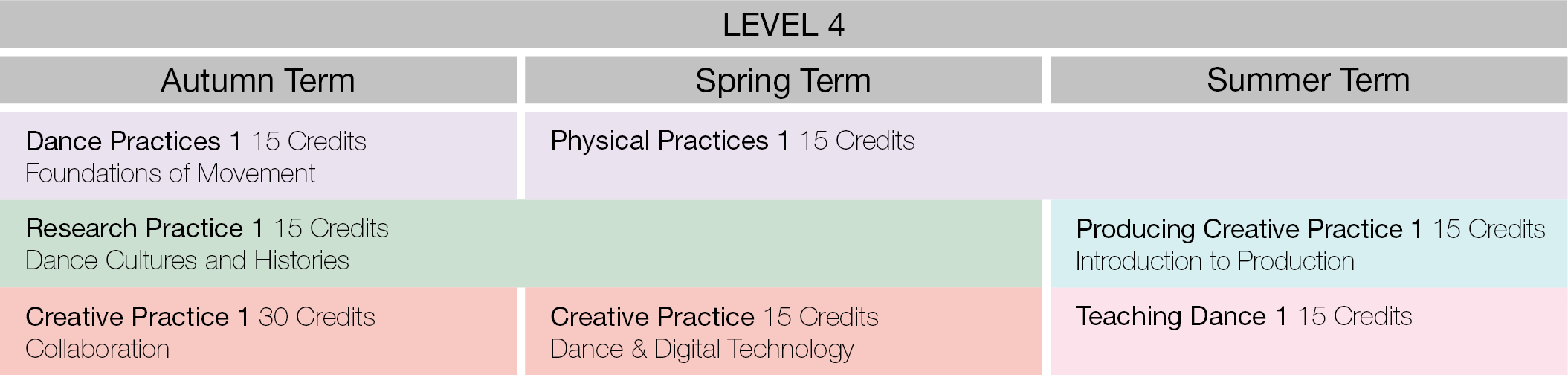
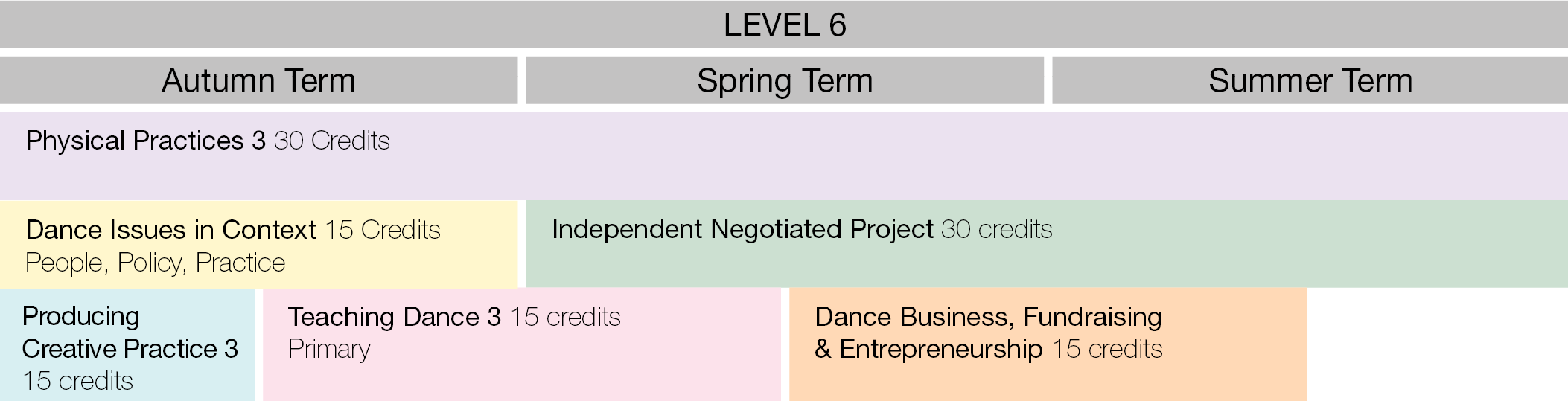
In this module, students will encounter the foundational principles of dance practices relevant to the current contemporary dance sector.
Students will be introduced to a broad range of dance practices/forms, through an integrated approach which ensures that students can gain understanding of traditional techniques, whilst also being introduced to more current and diverse approaches to dance training, as is fitting for this level of vocational training.
This module introduces research practices in dance through an exploration of diverse dance cultures and histories. It challenges dominant narratives within dance history and critically examines how issues of decolonisation, inclusivity, equity and equality shape our understanding of dance as a global, social, and political practice.
This module introduces students to the creative, practical, and theoretical foundations of collaborative group choreography. The focus of the module is on collective authorship, through which students will explore the dynamics of working within an ensemble to generate, refine, and perform original choreographic work. Through practical workshops, choreographic labs, and independent rehearsals, students will engage in movement exploration, improvisation, and compositional strategies to co-create group choreographic work.
This module introduces dance and movement practices with a focus on developing physical awareness, technical skill, and embodied understanding. Students will engage in regular studio-based classes that explore a range of movement approaches (such as: somatic practices, improvisation, dance and physical theatre techniques, yoga and Pilates) designed to build strength, coordination, adaptability, and expressive capacity. Emphasis is placed on embodied learning, encouraging students to reflect on the relationship between sensation, intention, and movement execution.
This module introduces the evolving field of dance and digital technology through exploratory creative practice. Students will investigate how digital tools, techniques and environments can extend, transform, and challenge traditional approaches to movement, choreography, and performance. Focusing on experimentation, students will engage with a range of digital media as part of a collaborative or individual creative process. Through guided workshops and independent research, students will explore how dance can be developed for live, digital, screen-based, interactive, or hybrid contexts.
This module offers an introduction to the principles and practices of producing within the context of dance festivals, events, and performances. Students will explore the role of the producer as a creative facilitator, organiser, and communicator, gaining insight into the processes that support the realisation of artistic work from concept to presentation.
In this module, students will learn the core skills relating to best practice in teaching, both in general terms, and with specificity to teaching dance. The focus of this module will be working internally within a peer-supported environment; however, consideration may be given to how these skills could be employed within different teaching contexts. This module integrates practice and theoretical approaches.
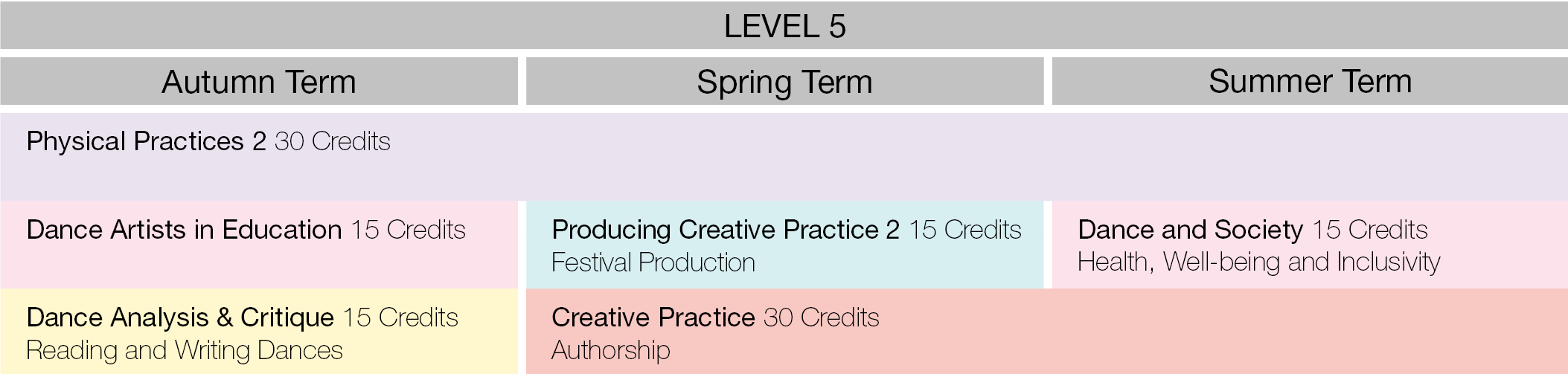
This module offers an in-depth exploration of physical and embodied movement practices, supporting the continued development of dance technique, physical intelligence, and somatic awareness. The module includes classes in contemporary dance techniques, somatic practices, and improvisational methods with an emphasis on embodied learning which supports developing and sustaining movement competencies, alongside a critical and reflective understanding of the principles and philosophies that underpin various physical practices.
This module explores the role of the dance artist as an educator in school and community contexts. It examines how artists contribute to education not by adopting the role of a traditional teacher, but by bringing their creative practice, artistic voice, and process-based approaches into learning environments. Through a combination of practical workshops, discussion of relevant scholarship in the field, and placement activity, students will investigate the principles of inclusive, creative, and student-centred dance education with consideration of the historical and cultural influence of the arts.
This module develops critical and analytical skills through the viewing, discussion, and written analysis of a range of dance and performance works. Drawing on traditions of dance criticism, performance analysis, and cultural commentary, students will explore how dance and performance can be interpreted, contextualised, and evaluated from multiple perspectives.
In this module, students will be introduced to the skills of arts project management and producing. They will receive input around organisation, publicity, curation and the different ideas and approaches that can be taken within arts project management.
This module invites a deep level of engagement with the concept of authorship in choreographic practice. Building on Level 4 experiences, the choreographer’s role as artist, author, and director will be explored, as students navigate creative decision-making, movement generation, and the articulation of personal or thematic intention within the fields of live performance and/or digital technology.
This module explores the intersecting areas of dance, health, well-being, and inclusivity, examining how dance functions as a social, artistic, and therapeutic practice across diverse communities and contexts.
This module builds on the work of the Level 4 and Level 5 Physical Practices modules, offering a further in-depth exploration of physical and embodied movement practices, which support the continued development and refinement of students’ technique, physical intelligence, and somatic awareness. The module includes classes in a range of Physical Practices, for example contemporary dance techniques, somatic practices, and improvisational methods with an emphasis on sophisticated embodied learning which supports advanced movement competencies, alongside a critical and reflective understanding of the principles and philosophies that underpin various physical practices.
This module explores the role of dance as a socially engaged and politically resonant practice, examining how artists across cultures and histories have responded to, resisted, and reshaped political contexts through movement and performance. Focusing on dance as a form of activism, expression, and commentary, the module investigates the relationship between choreographic and performance practices and socio-political change.
Building on learning from modules at Levels 4 and 5, Producing Creative Practice 3 offers the opportunity to engage with the professional realities of producing dance and creative arts events at an advanced level. This module brings academic learning into the workplace through a placement opportunity (on or off site), providing meaningful exposure to professional environments.
The Independent Negotiated Project offers the opportunity to undertake a self-directed research enquiry in a dance related field. Building on learning from across the programme, you will develop and present a project that demonstrates independent learning, depth of enquiry, and critical engagement with an area of dance practice or theory.
This optional module is aimed at those students wishing to pursue teaching dance as a significant/contributing part of their professional work, including those wishing to apply for further study on postgraduate teaching courses.
It will involve the delivery of advanced teaching techniques and skills specific to the needs of primary-aged teaching contexts, including but not limited to teaching methods, communication, demonstration, planning of age and level appropriate content/schemes of work, inclusive teaching strategies, reflexive practice, awareness of safeguarding and risk assessment.
This module provides knowledge and practical tools to help you navigate the professional dance and arts sector as an entrepreneurial, self-producing artist, project manager, or company founder. It introduces fundamental aspects of arts management, strategic planning, and fundraising specific to dance and creative industries.


The school is well equipped to facilitate students’ work in state-of-the-art facilities not shared by any other subject area or than dance.
See more here: Facilities – Northern School of Contemporary Dance
Our FacilitiesEntry is through a successful application and audition.
Additionally, candidates should usually have gained five GCSE passes (grade C/4 or above), which must include English Language, and two A Level passes or a L3 BTEC National diploma or professional/vocational training at an appropriate level.
Exceptions are made for 17-year-olds who are offered a place on the BA (Hons) Dance: Choreography, Producing and Teaching degree course, who would therefore not have completed A Levels or a full diploma etc.
Equivalent qualifications may also be accepted depending on the strength of the grades achieved. Equivalent level overseas qualifications are also accepted.
In some cases, applicants who don’t have the standard entry requirements will be required to complete the School Matriculation Task as part of their entry requirements.
Please see the Overseas Student pages for detailed English Language entry requirements.
Any questions about any of the above can be directed to admissions@nscd.ac.uk
Firstly, you will need to submit an application via our online application portal.
The application will include:
For more information, visit the How to Apply page.
In order to qualify for admission to this course, candidates are required to pass an audition process.
Applicants can chose to audition in-person at NSCD, or via video submission.
Audition Procedure:
For more information, visit the How to Apply page.
Individuals who are curious about themselves and the world around them, who can innovate and pave the way for the future of the artform.
Self-reflective individuals who demonstrate the capacity to form views and challenge their understanding of dance, art, performance and contexts in which they happen.
Individuals who posses the potential to apply a range of skills and competencies across creative work, production, arts management and contextual studies.
Individuals who can work as part of a group, with the ability to form and share ideas, pooling skills and knowledge in the pursuit of effective group working.
At NSCD, we understand that the dance industry is demanding, that’s why 100% of students requesting wellbeing support are seen within a week, demonstrating our commitment to student resilience. Student support is important because it directly affects academic success, wellbeing, and long-term development.
Learn more about how NSCD’s Student Services can assist you with academic, wellbeing, disability, and injury support: www.nscd.ac.uk/study/student-life/student-services
Student SupportAs part of your decision-making process, we appreciate you will want to research potential programmes of study ahead of application deadlines. To enable you to do this, we work hard to ensure that our website is as up to date as possible.
Although we try to ensure that this is as current as possible, there are always changes we make to ensure that the course is as vibrant and up to date with sector requirement as possible. Dance is a dynamic, fast-moving sector and our courses evolve to ensure they reflect and respond to the industry’s needs.
Sometimes it may be necessary to change course content, delivery and entry requirements, if we believe it will enable us to improve the high-quality experience we offer. Changes sometimes comes because of student feedback/consultations, external examiner feedback and consultation with industry partners.
All reasonable care has been taken to ensure course information is accurate, however NSCD cannot guarantee all courses will be available in exactly the form and detail described here. We encourage you to regularly check the pages of the course(s) you are interested in. At Open Days, Auditions, and Interview Days we will take the opportunity to inform you about any proposed changes and will also notify you if any changes are made after you have accepted an offer.
Our courses are made up of a series of modules. Some are compulsory and some optional, however, we may not be able to offer the full list of modules every year. Option availability will depend on how many students choose a particular option. For an option to run we usually stipulate that 13 students have chosen to take the option. When you accept your offer, please bear in mind that on rare occasions, we may not be able to offer all of the optional modules. Before each year’s teaching starts you will discuss your preferred options with the Head of Faculty and Curriculum Leads who will try to ensure you are able to take them but cannot guarantee it.