- Study
- Graduates
- What’s On
- Riley Theatre
- Take Part
- About
- Support us
- Search
Course Award: | Duration: | Application Deadline: | In Person Audition Dates: | Places: |
BA (Hons) | 3 years Full-time | Midnight 31 March 2026 | December 2025, February & April 2026 | 60 |
Specialist Training for Future Dance Artists
The BA (Hons) Contemporary Dance Performance degree is a course specifically designed for the education and training of professional contemporary dance artists.
The range of technical training undertaken during the programme is designed to train the body, whilst developing artistic intelligence and an understanding of movement that enables the dancer to respond to the varied and changing demands of contemporary choreography.
Students are encouraged to be curious about the place of contemporary dance within the broader landscape of the professional arts scene. We provide opportunities for students to work in collaboration with other arts organisations and professional settings, and for you to engage with different audiences at different stages of your professional training.
Through the programme, students embrace a range of industry-relevant modes of working, such as dance film, site-specific practice, social responsibility in dance, collective working, as well as a thorough grounding in traditional theatre practice.
NSCD is a Higher Education Institution and our Home fee-paying undergraduate students are entitled to the same financial assistance as students at UK Universities. This support includes government-sponsored loans and grants. Most Home fee-paying students are able to apply for a course fee loan to pay for fees and a maintenance loan to contribute towards living costs from the Student Loans Company.
Other types of financial assistance are available for applicants of low income households, care leavers, and refugees.
For detailed information on tuition fees, financial support, and associated costs for all courses, visit our Fees and Finance page here: www.nscd.ac.uk/study/fees-finance/undergraduate
Home | Overseas |
£9,790* | £19,570 |
*This is in line with DFE changes to tuition fees agreed in the Autumn budget
Find out more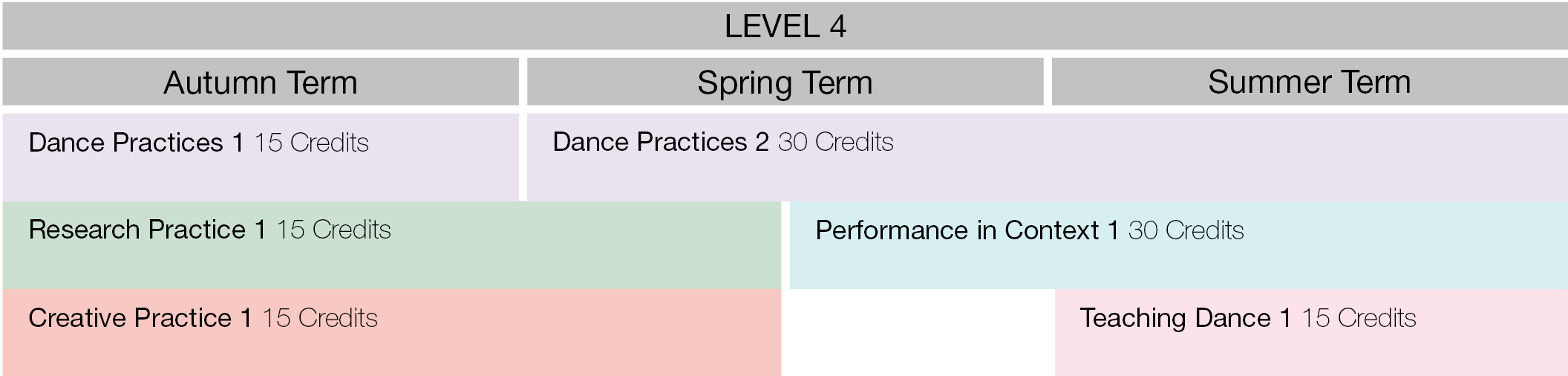
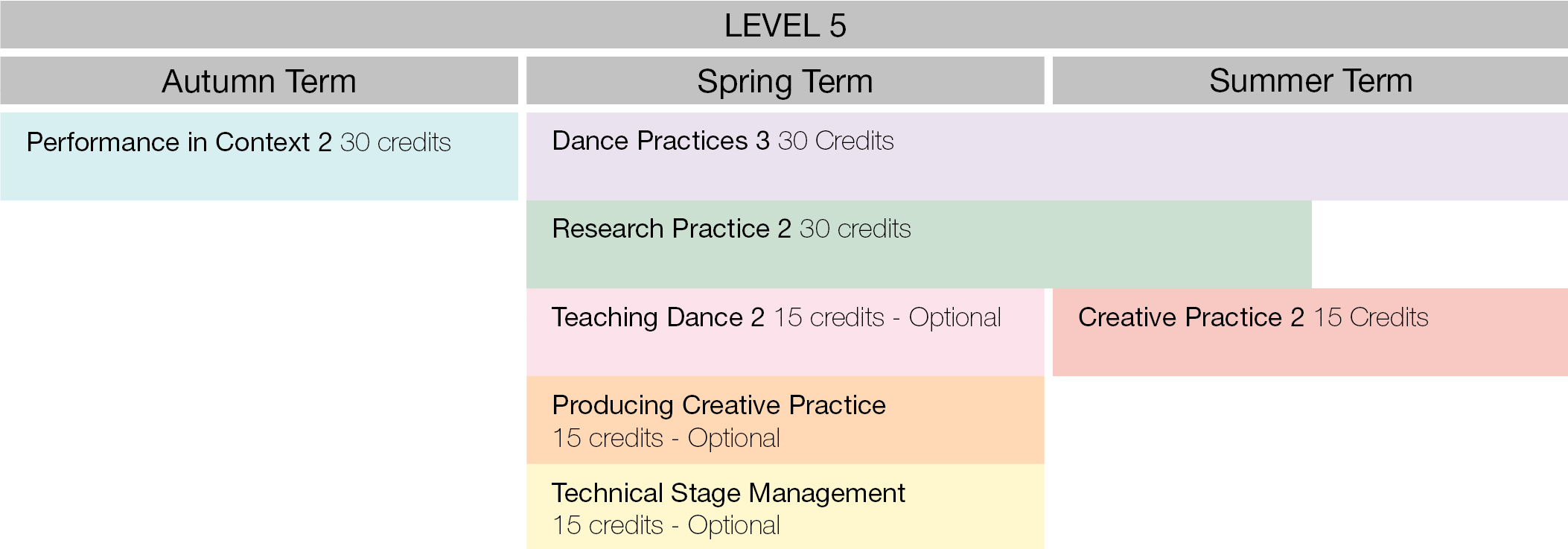
In this module, students will encounter the fundamental principles of dance techniques relevant to current contemporary dance practice, including ballet, tailored to the needs of contemporary dancers. The main focus is to embed healthy, productive working practices to underpin the individual learner’s progression through the entire course of study.
In this module, students will integrate learning from multiple perspectives, combining theory and practice, to generate an inclusive learning environment in which concepts are explored using a broad range of teaching methods. The module explores the body as a site of enquiry, supporting the development of a holistic approach to dance practice, where all activity presents an opportunity to question and be curious on a journey towards new understanding.
In this module, students will receive instruction into the core principles of devising and developing choreography, composition, improvisation, movement research and theatre practice. The main focus will be upon giving students a core set of skills and a fundamental understanding of key practices and practitioners from which to develop a complex understanding of choreography and movement language.
In this module, students will consolidate and expand upon the working practices introduced in the Dance Practices 1, supported by understanding the fundamental principles of movement, self-awareness, and core physical skills. There is a continuing emphasis on engagement with reflective practice as a means of developing core skills of anatomical awareness, appropriate physical strength and muscular effort, range of motion, proprioception, and coordination. In addition, the connection between imaginative and creative performance, and technical ability will be emphasised and explored, including the importance of musicality and phrasing. The vast majority of sessions will be practical and supported by theoretical and academic frameworks.
In the first five weeks of the module, students will be introduced to the specific creative and technical demands of a rehearsal and performance process. They will draw on relevant skills and understanding developed through previous experiences and learning in earlier modules to support their participation in the production of a dance work.
In the next section of the module, students will examine two areas that challenge their understanding of time and space in relation to movement using different modes of representation: site-specific/responsive working and dance film.
In this module, students will learn the core skills relating to best practice in teaching, both in general terms, and with specificity to teaching dance. The focus of this module will be working internally within a peer-supported environment; however, consideration may be given to how these skills could be employed within different teaching contexts. This module integrates practice and theoretical approaches.
This theatre-based module will integrate learning from multiple perspectives at Level 5, combining the delivery of dance practices with work that consolidates and extends students’ understanding of different modes of performance.
The first half of the term will focus on the exploration of solo work, culminating in the assessment of a live solo performance, and the second half of term will lead students into a 5-week group creation, rehearsal and public performance period.
In this module, students will consolidate and expand upon the core skills established at Level 4. There will be a focus on extending the integration of imaginative, creative, and musical performance qualities with set technical material through self-awareness and theoretical understanding. This will build on the work explored in Performance in Context 2, where students will have experienced dance technique sessions amalgamated into their assessment in the first term of study.
This module will look at developing contextual understanding and research skills around choreography and improvisation, as well as placing these movement skills within a wider arts context (e.g. music, film, theatre and the visual arts). This will include practical and theoretical development of skills in composition, choreography and improvisation as well as relating these to established models of movement analysis.
In this module, students will apply the skills learnt at Level 4 to a variety of educational contexts. Students will have the opportunity to undertake a teaching placement to apply their teaching skills in a different context. This will involve observation and assisting within a teaching environment outside of NSCD leading to independent delivery of sessions in an external setting. Students will be introduced to some of the professional standards surrounding teaching and pedagogy.
Students will be taught relevant practical skills and approaches to stage management and production elements in the first part of the course, underpinned by theory as relevant.
Students will then have the opportunity to engage with a range of technical tasks from working backstage to rigging, lighting operation and design, covering the range of learning undertaken throughout the course. This will include a number of professional opportunities covering projects undertaken in collaboration with NSCD and Riley Theatre (NSCD’s on-site professional dance house).
In this module, students will be introduced to the skills of arts project management and producing. They will receive input around organisation, publicity, curation and the different ideas and approaches that can be taken within arts project management.
This module will develop students’ approach to the application of choreographic and compositional tools in a range of contexts. It will look at the role art and dance play in a wider sociological and environmental context, encouraging students to think externally and beyond academic, institutional and national boundaries.
This module will focus on the exploration of site-specific working methods, supporting students to strengthen their ability to devise, refine, and perform effectively in non-conventional dance spaces. Students will devise and refine movement material with supervision from an in-house or guest director/choreographer and will take on key roles in all aspects of creating, rehearsing, performing and marketing the work.
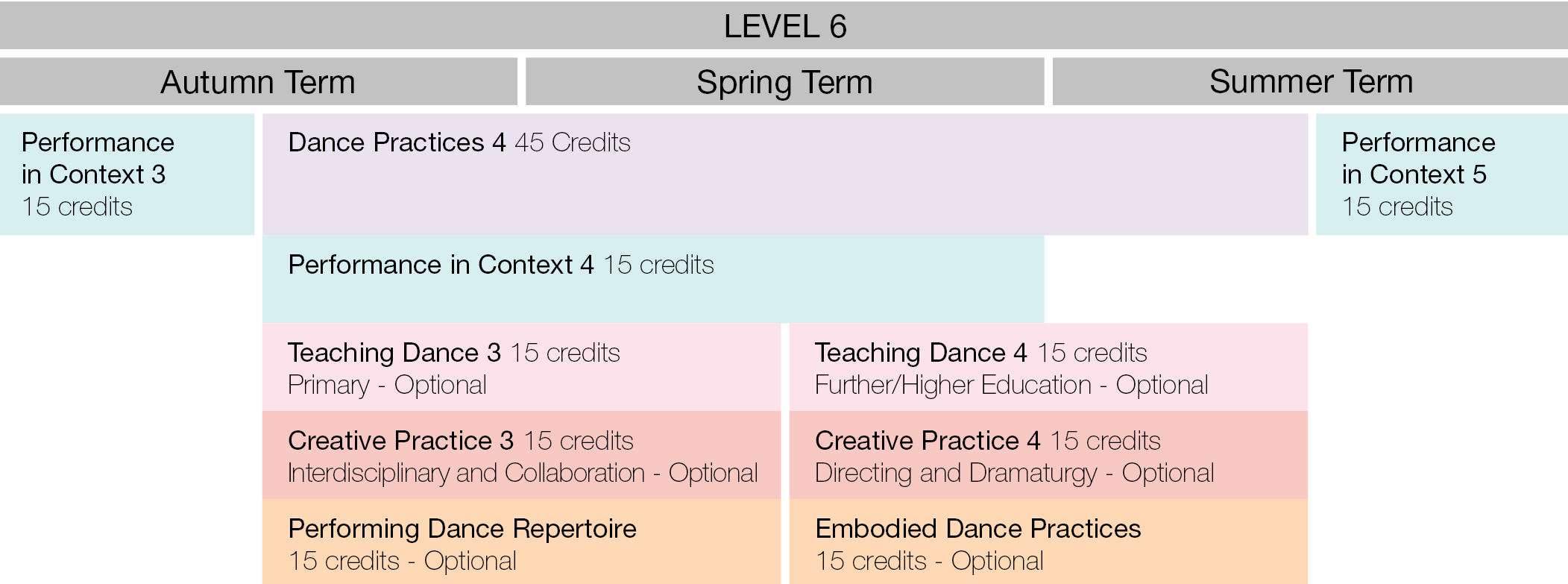
At the end of Level 6, students should have attained a strong grounding in the core principles of various dance practices, including but not limited to contemporary dance techniques. During this module, emphasis is placed on nurturing a confident and versatile dancer, who exhibits a solid technical ability and a high level of virtuosity. The aim is to combine, develop and extend technical skills through a variety of approaches that involve the study of more complex movement forms/variations.
This module will continue to integrate learning from multiple perspectives at Level 6, combining the delivery of dance practices with work that consolidates and extends students’ understanding of different modes of performance.
This module will focus on the exploration of improvisation within performance, supporting students to strengthen their ability to improvise, adapt, make decisions and refine/perform material in improvised contexts, culminating in the assessment of a live improvised performance piece.
This optional module is aimed at those students wishing to pursue teaching dance as a significant/contributing part of their professional work, including those wishing to apply for further study on postgraduate teaching courses.
It will involve the delivery of advanced teaching techniques and skills specific to the needs of primary-aged teaching contexts, including but not limited to teaching methods, communication, demonstration, planning of age and level appropriate content/schemes of work, inclusive teaching strategies, reflexive practice, awareness of safeguarding and risk assessment.
In this optional module, students will develop an individual research profile within a specific area of interdisciplinary dance practice. Building upon areas of study in the curriculum at Levels 4 & 5, the module encourages a multifaceted approach to individual study and ensures currency of student work in a constantly evolving dance world.
In this optional module, students will work in-depth to examine and interpret a range of contemporary dance repertoire. Students will be given an overview of a number of works, each with differing aesthetics, before focusing on a specific work to learn, refine and perform.
This optional module is aimed at those students wishing to pursue teaching within a further/higher educational context, either as a lecturer or as a contributing part of their professional work. Those interested in wishing to apply for further study on postgraduate teaching courses might also opt to study this module.
In this optional module, students will develop an individual creative and choreographic voice, building upon areas of study in the curriculum at Levels 4 & 5. The module encourages a multifaceted approach to individual study and ensures currency of student work in a constantly evolving dance world.
In this optional module, students will develop and refine advanced technical, creative and interpretive skills and understanding to undertake an in-depth research inquiry into an area of contemporary dance performance practice.
This dance theatre-based module will integrate learning from multiple perspectives, consolidating and extending students’ understanding of different modes of performance.
Students will experience a 5-week group creation, rehearsal and public performance period, led by a professional choreographer. There will be an emphasis on ensuring students are working towards professional levels of attainment, thus preparing them for their transition into the wider world of dance post-graduation.


The school is well equipped to facilitate students’ work in state-of-the-art facilities not shared by any subject area other than dance.
Our students become dance artists with highly tuned specialist knowledge, technical and creative skills, making them well-equipped to embark on a successful career in the arts. Many graduates progress onto further postgraduate study at NSCD or other Conservatoires/Universities.
Graduates from this course have gained employment as dancers in companies such as: Hofesh Shechter Company, Akram Khan Company, DV8, Scottish Dance Theatre, Candoco, Phoenix Dance Theatre, Motionhouse, Tanzmainz, 2Faced Dance, Stopgap, ACE Dance & Music, Gary Clarke Company, and many more. Others have forged a portfolio career and work in the broader arts industry as Producers, Choreographers, Teachers, Arts Managers, Dance Leaders and Freelance Artists around the world.





Entry is through a successful application and audition.
Additionally, candidates should usually have gained five GCSE passes (Grade C/4 or above), which must include English Language, and two A Level passes or an L3 BTEC National Diploma or professional/vocational training at an appropriate level.
Exceptions are made for 17-year-olds who are offered a place on the BA (Hons) Contemporary Dance Performance degree course, who would therefore not have completed A Levels or a full Diploma etc.
Equivalent qualifications may also be accepted depending on the strength of the grades achieved. Equivalent level overseas qualifications are also accepted.
Please see the Overseas Student pages for detailed English Language entry requirements.
In some cases, applicants who don’t have the standard entry requirements will be required to complete the School Matriculation Task as part of their entry requirements.
Any questions about any of the above can be directed to/further details can be obtained from admissions@nscd.ac.uk
Firstly, you will need to submit an application via our online application portal.
The application will include:
For more information, visit the How to Apply page.
Please note: Video auditions must be submitted at the same time as applications.
In order to qualify for admission to this course, candidates are required to pass an audition process.
Applicants can choose to audition in-person at NSCD, or via video submission. Please note: Video auditions must be submitted at the same time as applications (Step 1).
Audition procedure:
For more information, visit the How to Apply page.
Regardless of experience or training background, we seek dancers who demonstrate the physical potential to be trained to a high level.
Individuals who are curious about themselves and the world around them, who can innovate and pave the way for the future of the artform.
Self reflective individuals who demonstrate the capacity to form views and challenge their understanding of dance, art, performance and contexts in which they happen.
Dancers with the ability to communicate physically, and articulate intention and expression.
At NSCD, we understand that the dance industry is demanding, that’s why 100% of students requesting wellbeing support are seen within a week, demonstrating our commitment to student resilience. Student support is important because it directly affects academic success, wellbeing, and long-term development.
Learn more about how NSCD’s Student Services can assist you with academic, wellbeing, disability, and injury support: www.nscd.ac.uk/study/student-life/student-services
Find out moreAs part of your decision-making process, we appreciate you will want to research potential programmes of study ahead of application deadlines. To enable you to do this, we work hard to ensure that our website is as up to date as possible.
Although we try to ensure that this is as current as possible, there are always changes we make to ensure that the course is as vibrant and up to date with sector requirement as possible. Dance is a dynamic, fast-moving sector and our courses evolve to ensure they reflect and respond to the industry’s needs.
Sometimes it may be necessary to change course content, delivery and entry requirements, if we believe it will enable us to improve the high-quality experience we offer. Changes sometimes comes because of student feedback/consultations, external examiner feedback and consultation with industry partners.
All reasonable care has been taken to ensure course information is accurate, however NSCD cannot guarantee all courses will be available in exactly the form and detail described here. We encourage you to regularly check the pages of the course(s) you are interested in. At Open Days, Auditions, and Interview Days we will take the opportunity to inform you about any proposed changes and will also notify you if any changes are made after you have accepted an offer.
Our courses are made up of a series of modules. Some are compulsory and some optional, however, we may not be able to offer the full list of modules every year. Option availability will depend on how many students choose a particular option. For an option to run we usually stipulate that 13 students have chosen to take the option. When you accept your offer, please bear in mind that on rare occasions, we may not be able to offer all of the optional modules. Before each year’s teaching starts you will discuss your preferred options with the Head of Faculty and Curriculum Leads who will try to ensure you are able to take them but cannot guarantee it.